
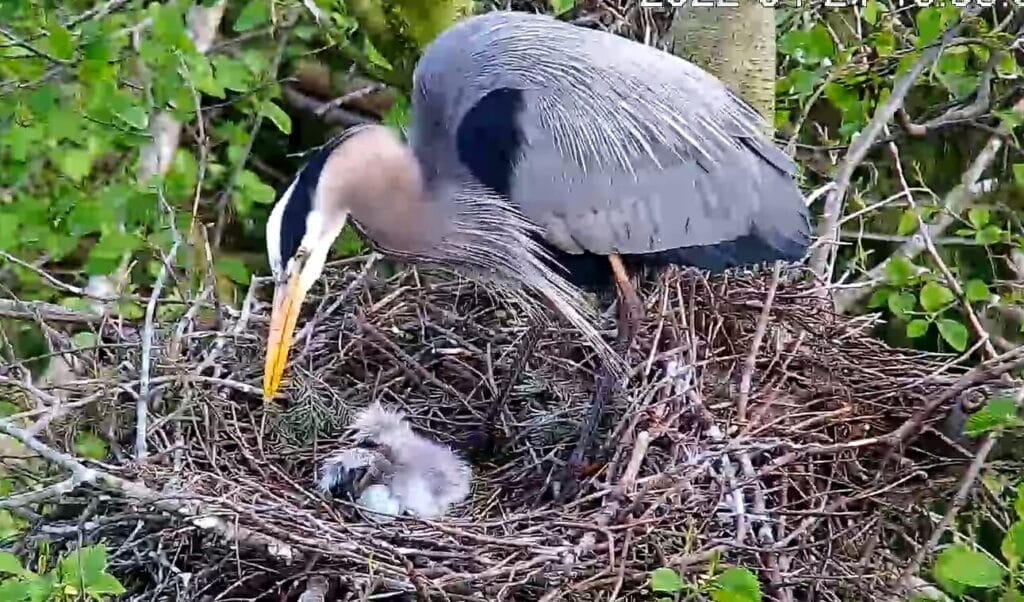
Skagit Land Trust operates three wildlife cameras high in the canopy of the Trust’s March Point Heronry Conservation Area. Located near Anacortes, this property is home to one of the largest Great Blue Heron colonies in the western United States. The Trust’s solar-powered cameras offer a “bird’s-eye” view of the nesting behavior during the months that the heronry is occupied (usually April through August).
Heron Camera Live Feed
The March Point Heron cameras livestream during nesting season (Mid-April through August) between 9am and 5pm Pacific Time. When cameras aren’t live, you can watch clips from past seasons.

History of the Camera
Skagit Land Trust established the first camera in the heronry in 2006, in cooperation with Padilla Bay National Estuarine Research Reserve and in partnership with a Leadership Skagit “Heron Team.” The Leadership Skagit team secured donations from several businesses, community groups, and individuals. In 2014, after the single camera stopped working, Trust members, local businesses, and regional foundations helped replace the system. In 2022, the Trust’s passionate membership funded a new upgraded system featuring three cameras and an expanded and relocated solar power unit to provide a more comprehensive look into the heronry.
More from the Feed
Live Heron Hatchlings
Clips from 2024 that witnessed courtship, egg laying, heron hatching, as well as young herons finally fledging and leaving the colony at the end of July.

March Point Heronry East Camera
Footage from the Heron Cam from 2022.

March Point Heronry Camera System
Learn about community science efforts at the heronry and an overview of installing the new camera system.
About the March Point Heronry
In 1994, Vera and Bud Kinney donated seven acres of forest between Padilla and Fidalgo Bays to Skagit Land Trust to protect the nesting herons from encroaching development. Additional acquisitions and conservation easements have expanded protection of this important heronry to over 15 acres. Learn more about the March Point Heronry property.
Support the March Point Herons!
The March Point Heronry is small in acreage, but large in importance. At 700 nests, this heronry is the biggest colony of Great Blue Herons on the entire west coast of the United States.
Your financial support allows us to continue to care for these special birds and steward the March Point Heronry. The heron cameras wouldn’t be possible without donors like you.
Monitoring
Nesting Season Observations
Through the three heron cameras within the colony, teams of observers are able to watch the behavior of the birds, from reoccupation of the colony in late February or early March, through courtship and egg laying, heron hatching, and finally young heron fledging and leeaving the colony two months after they’ve hatched. Observers look at nearly 350 nests and count eggs, chicks, and hatchlings that survive through fledging. As a large contributor to the gene pool of the Salish Sea Great Blue Heron, this data contributes valuable information about the productivity of the colony. A small team of observers also watch from outside the heronry, providing additional information not captured through the cameras. Protocols for nesting season observations were developed with the expertise of wildlife biologist Ann Eissinger, who consults on many community science heron projects.
Nest Counts
With the cooperation of neighboring landowners, Skagit Land Trust conducts a nest count in the heronry each year. In 2025, over 500 heron nests were counted in this relatively small area. Because Skagit Land Trust does not have access to all neighboring property, some heron nests are uncounted. The overall trend, however, shows an increasing number of heron nests in the colony on SLT property and the property to which we have access — and there are likely to be dozens more nests on the adjacent property to which we do not have access. Combined with information gathered from an active nest tree count shortly after the herons leave the colony each summer, the Trust can determine how many of the nests in the trees are utilized each year. These counts help assess the number of herons that depend on the colony for nesting and reproduction.
Additional Monitoring
Since 2014, volunteers have also observed hunting and foraging behavior of herons through a Forage Area Monitoring project around Padilla Bay. Although Skagit Land Trust does not coordinate this effort, information gathered through all the heron community science projects contributes valuable information on the natural history of Great Blue Heron of the Salish Sea.
Public Access
Due to the sensitive nature of the heron nesting habitat, the March Point Heronry is closed to public access.