

Skagit Land Trust is committed to ethical and transparent leadership and responsible practices. We take our commitment to our donors seriously, for without your trust we cannot fulfill our mission.
For detailed information about our Bylaws and our Conflict of Interest Policy, click below.
BYLAWS OF SKAGIT LAND TRUST
Article I: PURPOSES
The purposes of the corporation include preserving for posterity scenic open spaces, forest and agricultural land, wetlands, shorelines, and wildlife habitat. To realize these purposes, the corporation will, among other actions, accept donations of, and purchase conservation easements, and accept donations of, and purchase land. It will manage such acquisitions in an environmentally sound manner for the long-range benefit of the community.
Article II: MEMBERSHIP
Section 1. Qualification. All persons who support the purposes of the corporation may become and remain members upon approval of the Board of Directors and the payment of annual dues. The Board may expel a member from the corporation upon a two-thirds affirmative vote to do so.
Section 2. Dues. The corporation shall have members who are designated by categories and annual contribution amounts to be determined from time to time by the Board of Directors.
Section 3. Rights. All categories of members shall enjoy the same rights and privileges, including the right to one vote per membership for members of the Board of Directors and to serve on committees of the corporation to which they are appointed. The Board of Directors may, at its discretion, establish special recognition for specific categories of members.
Article III: ANNUAL MEETING
The Annual Meeting of the corporation for the purpose of electing members of the Board of Directors and conducting other business which may properly come before the meeting shall be held during the first calendar quarter of each year at a time and place to be determined by the Board of Directors. Notice of the date, time and place of the Annual Meeting shall be provided to all members of the corporation at least thirty (30) days in advance by mail, email or fax as directed by the Secretary. A quorum shall consist of those members present at the meeting.
Special meetings of the corporation may be called by the Board of Directors at its discretion, upon 10 days’ notice to the membership.
Article IV: BOARD OF DIRECTORS
Section 1. Powers. The property, affairs and activities of the corporation shall be managed by a Board of Directors consisting of from five (5) to twenty-one (21) members. The powers of the Board of Directors shall include the authority to accept, transfer, sell, purchase and encumber property and interests in property; and the authority to retain any necessary staff or contractors. The Board may, at its discretion, and upon approval of any transaction, appoint an Ad Hoc Committee of Board members to finalize details of said property transaction.
Section 2. Election. Directors shall be members of the corporation and shall be elected by the membership at the Annual Meeting of the corporation; each shall serve until a successor is elected and qualified; or until they resign or until dismissed by the board pursuant to Article IV, Section 5.
Section 3. Terms. All members of the Board of Directors shall be elected for a three-year term, unless a shorter term is stated in advance to maintain staggered terms, and shall assume their positions at the Annual Meeting at which they were elected.
Section 4. Staggered Terms. The terms of members of the Board of Directors shall expire on a rotating basis.
Section 5. Removal. Any director or officer of the corporation may be removed by affirmative vote of two-thirds of the entire Board of Directors for non-performance of duties including meeting attendance, or other cause deemed sufficient by the Board.
Section 6. Vacancies. The Board may fill vacancies until the next annual meeting for the remainder of the vacant terms.
Section 7. Meetings. The Board of Directors shall meet monthly at least 10 times per year as determined by the Board. Special meetings may be held whenever called by the President or by any four or more directors for prestated purposes only.
Section 8. Notice of Regular Meetings. Notice of the time and place of regular Board meetings shall be given by mail, email or fax at least five days prior to the date on which the meeting is to be held at the direction of the Secretary.
Section 9. Notice of Special Meetings. Notice of special meetings of the Board for a prestated purpose shall be mailed, emailed, faxed or telephoned at the direction of the Secretary, or person(s) calling the meeting, at least four days prior to the special meeting.
Section 10. Annual Meeting. The Annual Meeting of the Board shall be held at the same place and date as the Annual Meeting of the corporation and at such time as the Board of Directors shall determine.
Section 11. Quorum. One-third (1/3) of the members of the Board of Directors shall constitute a quorum for the transaction of business. The act of the majority of directors present at a meeting at which a quorum is present shall be the act of the Board of Directors except when provided elsewhere in these By-Laws.
Section 12. Directors’ Action Without Meeting. Any action required or permitted to be taken by the Board of Directors may be taken without a meeting, upon notification to, and response from all Board members by email or fax and after unanimous approval of the Board members who are eligible to vote. That action shall have the same force and effect as if approved at a regular or special Board meeting. Individual Board members shall confirm their vote and the Secretary shall confirm, record and file these confirmations with the minutes of the Board Meeting.
Section 13. Waiver of Notice of Meeting. Attendance of a director at a meeting shall constitute a waiver of notice of such meeting, except where a director attends the meeting for the express purpose of objecting to the transaction of any business because the meeting is not lawfully called or convened. Objections to the propriety of notice may be also hand delivered to the Secretary of the corporation prior to the meeting with the same effect as if the board member so objecting had appeared at the meeting.
Section 14. Reimbursement of Expenses. All officers and directors may be reimbursed for expenses actually incurred subject to approval by the Board of Directors.
Section 15. Conflicts of Interest. From time to time, a Board member or officer of this corporation may be a director, officer, employee, or member of another corporation, association, firm or entity which is interested in a transaction or contract with this corporation. All such interests must be disclosed in advance of approval of a transaction or contract. In the absence of fraud, such a contract or transaction shall not be void or voidable for this reason as long as the Board member or officer leaves the room during the discussion and abstains from voting on the action. The director or officer shall not be required to account to this corporation for any profits or benefits therefrom if the transaction or contract is or shall be authorized, ratified or approved by a vote of two-thirds (2/3) of the members of the Board of Directors. Nothing herein contained shall create any liability in the events described or prevent the authorization, ratification or approval of such transactions or contracts in any other manner.
Article V: OFFICERS
Section 1. Officers Listed. The officers of the corporation shall include a President, a Vice President, a Secretary and a Treasurer and others elected by the Board.
Section 2. Election of Officers. Each officer shall be elected from the membership of the Board at the annual meeting of the Board of Directors or at any subsequent Board meeting. All officers shall serve until the next annual meeting of the Board of Directors or until their successor is duly elected and qualified. All officers are voting members of the Board of Directors.
Section 3. Duties. The duties of the officers are as follows:
a. President. The President shall exercise the usual executive powers pertaining to the office of President and shall preside at meetings of the Board of Directors, the Executive Committee and at the Annual Meeting.
b. Vice President. The Vice President shall act as President in the absence or disability of the President.
c. Secretary. The Secretary shall keep or cause to be kept minutes of all meetings of the membership, the Board of Directors, the Executive Committee and any Ad Hoc Committees appointed to finalize details of property transactions; keep a file of the official documents and records of the corporation as directed by the Board. The Secretary shall send or cause to be sent notices of all meetings of the Board of Directors and Executive Committee.
d. Treasurer. The Treasurer shall have the care and custody of and be responsible for all funds and investments of the corporation and shall cause to be kept regular books of account. They shall cause to be deposited all funds and other valuable effects of the corporation, in such depositories as may be determined by the Board of Directors. The Treasurer remains responsible for the actions of the Assistant Treasurer should the Board elect an Assistant Treasurer.
e. Additional Duties. Additional duties and job descriptions for the above-named corporate officers may be provided for by written job descriptions prepared by the Board of Directors.
Section 4. Vacancies. Vacancies in any office arising from any cause shall be filled by the Board of Directors at any regular or special meeting.
Section 5. Removal. Any officer may be removed by a majority vote of the Board of Directors whenever in its judgment the best interests of the corporation will be served thereby.
Article VI: EXECUTIVE COMMITTEE
Section 1. The Board of Directors shall elect an Executive Committee consisting of the officers of the corporation and one additional director.
Section 2. The Executive Committee shall meet monthly and act for the Board of Directors between meetings and shall exercise all powers of the Board except those which have been expressly reserved by resolution of the Board or these By-Laws and the acceptance, purchase or disposition of land and the acceptance or purchase of conservation easements. Notice of the date, time and place of the meeting shall be provided by mail, email or fax to all board members at least five (5) days in advance as directed by the Secretary. A quorum shall consist of three (3) members. Action approval would require a minimum of three (3) affirmative votes.
Section 3. The Executive Committee shall act as the Finance Committee of the corporation, the Personnel Committee and the Conflict of Interest Review Committee.
Section 4. The Executive Committee shall report its decisions and actions to the Board of Directors at the Board’s next meeting.
Article VII: INDEMNIFICATION AND LIABILITY OF DIRECTORS AND OTHERS.
Section 1. Director Liability. A director of the corporation shall not be personally liable to the corporation for monetary damages for conduct as a director, except for liability of the director as follows:
a. For acts or omissions which involve intentional misconduct by the director or a knowing violation of the law by the director; or
b. For any transaction from which the director will personally receive benefit in money, property or services to which the director is not legally entitled.
If the Washington Nonprofit Corporation Act is amended to authorize corporate action further eliminating or limiting the personal liability of directors, then the liability of a director of the corporation shall be eliminated or limited to the fullest extent permitted by the Washington Nonprofit Corporation Act, as so amended. Any repeal or modification of the foregoing paragraph by directors or members, if any, of the corporation shall not adversely affect any right or protection of a director of the corporation existing at the time of such repeal or modification.
Section 2. Indemnification.
a. The corporation has the power to indemnify, and to purchase and maintain insurance for its directors, officers, employees, and other persons and agents, and (without limiting the generality of the foregoing) shall indemnify its directors, against all liability, damage, and expenses arising from or in connection with service for, employment by, or other affiliation with this corporation or other firms or entities to the maximum extent and under all circumstances permitted by law.
b. Each person who was or is made a party or is threatened to be made a party to or is involved (including, without limitation, as a witness) in any actual or threatened action, suit or proceeding, whether civil, criminal, administrative or investigative, by reason of that fact that they are or were a director or officer of the corporation or, being or having been such a director or officer, they are or were serving at the request of the corporation as a director, officer, employee or agent of another corporation or of a partnership, joint venture, trust or other enterprise, plans, whether the basis of such proceeding is alleged action in an official capacity as a director, officer, employee or agent or in any other capacity while serving as a director, officer, employee or agent or in any other capacity, shall be indemnified and held harmless by the corporation to the full extent permitted by applicable law as then in effect, against all expense, liability and loss (including, without limitation, attorney’s fees, judgments, fines, ERISA excise taxes) or penalties and amounts to bepaid in settlement actually or reasonably incurred or suffered by such person in connection herewith. Such indemnification shall continue as to a person who has ceased to be a director, officer, employee or agent and shall inure to the benefit of their heirs, executors and administrators. No indemnification shall be provided under this Article to any such person if the corporation is prohibited by the applicable law as then in effect from paying such indemnification. The right to indemnification conferred in this Section shall be a contract right and shall include the right to be paid by the corporation the expenses incurred in defending any such proceeding in advance of its final disposition; provided, however, that the payment of such expenses in advance of the final disposition of a proceeding shall be made to or on behalf of a director or officer only upon delivery to the corporation of an undertaking, by or on behalf of such director or officer, to repay all amounts so advanced if it shall ultimately be determined that such director or officer is not entitled to be indemnified under this Article or otherwise, which undertaking may be unsecured and may be accepted without reference to financial ability to make repayment.
c. The right to indemnification and the payment of expenses incurred in defending a proceeding in advance of its final disposition conferred in this Article shall not be exclusive of any other right which any person may have or hereafter acquire under any statute, provision of the Article of Incorporation, By-Laws, agreement, vote of the disinterested directors or otherwise.
d. The corporation shall maintain insurance, at its expense, to protect itself and any director, officer, employee or agent of the corporation or another corporation, partnership, joint venture, trust or other enterprise against any expense, liability or loss, whether or not the corporation would have the power to indemnify such person against such expense, liability or loss under the Washington Nonprofit Corporation Act. The corporation may enter into contracts with any directors or officers of the corporation in furtherance of the provisions of this Article and may create a trust fund, grant a security interest or use other means (including, without limitation, a letter of credit) to ensure the payment of such amounts as may be necessary to effect indemnification as provided in this Article.
e. The corporation may, by action of its Board of Directors from time to time, provide indemnification and pay expenses in advance of the final disposition of a proceeding to officers, employees and agents of the corporation with the same scope and effect as the provisions of this Article with respect to the indemnification and advancement of expenses of directors and officers of the corporation or pursuant to rights granted pursuant to, or provided by, the Washington Nonprofit Corporation Act or otherwise.
Article VIII: COMMITTEES
Section 1. Directors Committees. The President, with the approval of the Board, may when deemed necessary appoint committees of directors and /or members for specific purposes. These may include the following:
a. Land Committee – to investigate, evaluate and recommend lands suitable for protection by the corporation. The land committee shall be made up of board members and staff.
b. Stewardship Committee – to monitor and maintain easements and lands owned by the corporation and to advise on stewardship issues and long-term costs when protecting lands. The stewardship committee shall be made up of board members and staff and may also include other Trust members.
c. Development Committee – to provide oversight of fundraising activities, to raise funds in
support of annual operations and dedicated funds through membership, major donors, businesses and organizations, grants, special events and activities, planned giving, capital campaigns and other methods allowable for non-profit corporations. The development committee shall be made up of board members and staff and may also include other Trust members.
d. Outreach Committee – to develop and maintain a Communication and Outreach Plan that educates members, volunteers, landowners and the general public on the Trust’s mission of land conservation, on its current work and strategic goals, and on ways to engage with the Trust. Communication and Outreach is accomplished through print and electronic media, the annual meeting, special events, activities and personal communication. The committee works to encourage growth in membership, volunteering, and conservation with willing landowners. The committee works to educate the public, including youth and those communities not yet reached, about land conservation and the Trust’s work. The committee oversees community relations to build a positive image in the community. The outreach committee shall be made up of board members and staff and may also include other Trust members.
e. Public Policy Committee – To advise the Trust’s actions and statements regarding land-use policies, decisions and activities that directly impact Skagit Land Trust’s work. The committee helps the Trust’s board and staff to address public policy matters in a timely and effective manner that is consistent with the values articulated in the Mission Statement. The public policy committee shall be made up of board members and staff and may also include other Trust members.
f. Investment Committee – To oversee the Trust’s investments and make recommendations to the board regarding all investment matters including selection of investment managers. They are guided by the Trust’s investment policy and may suggest changes to this policy from time to time. The investment committee shall be chaired by the Treasurer and made up of board members, staff and Trust members with appropriate investment skills to assist in guiding the Trust’s financial investments.
g. Facilities Committee –To oversee the Trust’s buildings, infrastructure and other large physical assets including vehicles. The committee helps the Trust’s board and staff to plan, budget for, and implement matters concerning infrastructure in a timely and effective manner that is consistent with the values articulated in the Mission Statement and appropriate Property Management Plans. The committee shall be made up of board members and staff, and may also include other Trust members.
Section 2. Governance Committees.
The President shall appoint, with the approval of the Board, a Governance Committee of five (5) members who are members of the corporation, including directors. The chairman shall be a director. The function of the committee is to:
a. Nominate directors for election to the Board of Directors;
b. Consider candidates, if any, recommended by members of the corporation; such recommendations shall be in petition form endorsed by at least five (5) members and submitted to the Committee at least six (6) weeks prior to the Annual Meeting.
c. Provide for the orientation and training of the Board of Directors in the business of the corporation and in the governance of non-profit corporations. This may include inviting speakers or consultants to Board meetings and/or staging Board retreats.
d. Review by-laws and propose changes as necessary.
Section 3. Advisors. The President, with the approval of the Board, may appoint Advisors to advise the Board and assist in fundraising and public relations.
Article IX: FINANCIAL AFFAIRS
Section 1. Fiscal Year. The fiscal year of the corporation shall be determined by resolution of the Board of Directors.
Section 2. Loans
a. Loans to the corporation. In keeping with its fiduciary responsibility, the board may secure loans beneficial to the operation of the corporation and the pursuit of its mission. Approval of a loan to the corporation shall require a two-thirds (2/3) majority vote of the Board of Directors. The President, or in their absence the Vice-President is authorized to execute loan documents once the Board votes its approval.
b. Loans by the corporation. In keeping with its fiduciary responsibility, the board may extend a loan should the purpose of the loan be deemed by the board to be consistent with the corporation’s mission and on terms deemed beneficial to the corporation via a due diligence process deemed satisfactory by the board. Approval of a loan by the corporation shall require a two-thirds (2/3) majority vote of the Board of Directors.
c. Personal loans. No loans shall be made by the corporation to any officer, director, employee or other insider of the corporation.
Section 3. Conflict of Interest.
Per Article IV, Section 15, of the Skagit Land Trust Code of Policies, Board Members must reveal any conflict of interest involved with a loan.
Section 4. Insurance. The Board of Directors shall secure insurance to protect the corporation and the Board of Directors and the officers from liability.
Section 5. Disbursements.
Disbursements shall be made only in accordance with a specific authorization or a general budget approved by the Board of Directors and on such terms as may be established by the Board.
Section 6. Annual Audit. An audit or review, by an independent certified public accountant, of the corporation’s books shall be undertaken annually in a manner to be determined by the Board.
Article X: RULES OF PROCEDURE
The rules of procedure at meetings of the Board of Directors and the corporation shall be those contained in Robert’s Rules of Order on Parliamentary Procedure, so far as applicable and when not inconsistent with these Bylaws, the Articles of Incorporation or any resolutions of the Board of Trustees.
Article XI: AMENDMENTS
These Bylaws may be amended by an affirmative vote of three-quarters (3/4) of the entire Board of Directors, provided that notice of the nature of the proposed amendment has been mailed, faxed or transmitted electronically to all directors at least ten (10) days in advance of the meeting.
The amendment further must be approved by a majority vote of the members present at an Annual Meeting or a special meeting of the corporation at which advance notice of at least 10 days has been given of the nature of the proposed amendment.
Article XII: DISSOLUTION
A resolution to dissolve the corporation may be adopted upon a three-quarters (3/4) vote of the Board of Directors. The distribution of assets of the corporation shall follow the requirements of RCW 24.03.225, except that all assets remaining after all liabilities and obligations have been discharged shall be distributed to those nonprofit corporations, as defined by Internal Revenue Code 501 (c), selected by the Board of Directors by a three-quarters (3/4) vote. Distribution of the assets pursuant to the Articles of Incorporation shall take place only upon involuntary dissolution.
4.0 Conflict of Interest Policy (amended Feb 2 2006, amended Nov 3 2011; amended July 18 2013; amended Aug 6 2020, June 25 2021)
4.1 Policy Statement: It is the policy of Skagit Land Trust to identify and resolve conflicts of interest involving the Trust and covered persons as well as situations which give the appearance of a conflict of interest.
4.2 Purpose:
- To ensure that Skagit Land Trust maintains the highest level of integrity and transparency in all areas of conduct
- To ensure that the Trust maintains public trust and confidence
- To ensure compliance with IRS and other governmental regulations and requirements including avoidance of “excess benefit” and “private inurement” for insiders.
- To ensure that the Trust maintains its fiduciary responsibility at all times.
4.3 Primary Areas of Focus: - General Operations
- Land Transactions
4.4 Concepts & Terminology Defined:
A. Conflict of Interest A conflict, or a perceived conflict, exists when a covered person (defined below) is in a position to act on or influence a decision by Skagit Land Trust when that person’s interests may differ from or be in conflict with the interests of the Trust, especially if the covered person has a material, financial interest in a transaction or project under consideration by the organization.
B. Inside/Proprietary Information Any material information that is identified as confidential and proprietary, pertaining to Skagit Land Trust’s interests, activities and policies.
C. Excess Benefit/Private Inurement Giving inappropriate benefit to private parties (insiders) without getting equivalent goods or services in return. This can include unreasonable employee compensation or the disposition of or rental of property to board members or staff at less than fair market value.
D. Covered Persons (Insiders) Any person who at any time during the five-year period ending on the date of the transaction involved was in a position to exercise substantial influence over the affairs of the organization (whether by virtue of being an organization manager or otherwise) and for a five-year period following completion of the transaction. This includes all board members and employees as well as key volunteers, close relatives, major donors, related organizations and other insiders as described below. (The IRS specifies covered persons as “disqualified persons” or DQs)
E. Key Volunteers Any person involved with Trust operations on a volunteer basis who has access to proprietary information and/or is in a position to exert influence or act on decisions made by the Trust.
F. Close Relative Spouse, child (natural or adopted), parent, step-parent, in-law, grandchild, grandparent, brother or sister of a covered person or any person with whom a covered person shares living quarters under circumstances that closely resemble a marital relationship or who is financially dependent on or interdependent with the covered person.
G. Major Donor An individual, corporation or foundation that makes a gift or pledge of $10,000 or more at any one time or $50,000 or more over a period of five years in cash, appreciated securities, other assets or in land, easement or bargain-sale value.
H. Other Possible Insiders Depending On Circumstances Individuals, such as: - former board members
- former employees
- former key volunteers
- current or former Advisory Council members
- current or former Trust committee members
- independent contractors (depending on facts and circumstances). These individuals may be deemed insiders by virtue of their continued involvement with the Trust if they have access to inside information not available to the general public and/or have the ability to influence decisions of the organization
I. Related Organizations Any organization in which a covered person directly or indirectly:
- owns or controls 35% or more of any voting security, or
- is a director, executive officer, executor, administrator, trustee,
beneficiary, controlling partner, or otherwise serves in a fiduciary capacity
or holds a substantial beneficial interest, or - has legal or de facto power to control the election of a majority of
directors, or - has legal or de facto power to exercise a controlling influence over the
management or policies
“Organization” includes, but is not limited to, a corporation, partnership, trust, estate, joint venture and unincorporated affiliation of any kind as well as public boards and commissions and non-profit organizations.
J. Qualified Independent Appraisal For conservation real estate transactions, an independent appraisal prepared in compliance with the Uniform Standards of Professional Appraisal Practice by a Washington state-licensed or state-certified appraiser who has verifiable conservation easement or conservation real estate experience. For other items, a qualified appraisal done by a qualified appraiser.
K. Independent Economic Substantiation An independent assessment of the value of a real property or tangible property other than by a qualified independent appraisal. It may include a qualified appraisal review or a market appraisal by a qualified professional such as a real estate agent knowledgeable with conservation easements or property. It may also include evaluation by a qualified professional for value of timber, mineral, water and other rights or for tangible property such as artwork, antiques, vehicles, etc. For services, an authorized group of individuals who do not have a conflict of interest may pre-approve the service after reviewing “appropriate data” to assess comparability with fair market value and ensure
compensation is justifiable. “Appropriate data” should include at least three comparables.
L. Widely Marketed Announcing the availability of a property for sale to lists of prospective buyers, through Web pages, mailings, and listings in local newspapers, newsletters and other publications or media. “Widely marketed” does not require public listing with a real estate agent.
4.5 Identifying a Conflict
4.5.1 Conflict Identification It is important to first identify a potential conflict of interest or appearance of conflict. This may happen in one of two ways:
A. The insider brings the conflict to the Trust’s attention
B. The potential conflict should be referred to the Executive Committee, acting as the Conflict of Interest Committee, which will review the facts and determine if a conflict does indeed exist and recommend a course of action to the Board of Directors. If the conflict in question involves a member of the Executive Committee, that person shall withdraw from all consideration and discussion, recuse themselves (be absent) and not participate in the final decision. Potential conflicts may be reported anonymously by mail, phone or email to the Executive Director, unless that is the person under consideration; or to any member of the Executive Committee.
4.5.2 Whistleblower Indemnification If another individual, especially an employee, refers a potential conflict to the Trust, that person will be protected from any retaliation or punishment such as termination of employment, demotion or salary reduction or dismissal from the board.
4.5.3 Payment to Board Members for Services. Board members do not serve for personal financial interest and are not compensated except for reimbursement of expenses. In extremely limited circumstances, they may be considered for professional services that would otherwise be contracted out. Services must be offered at or below market value and any compensation must be in compliance with charitable trust laws. The board’s president and treasurer and / or firms, companies or entities for whom they work may never be compensated for professional services either directly or indirectly.
4.6 General Operations
4.6.1 Advanced Approval: Advanced approval by the board for all actions involving conflicts is required, with the board acknowledging the conflict and determining that the transaction is fair, or providing explanations of why the conflicted action is in the best interests of the Trust.
4.6.2 Policy Guidelines: Policy guidelines applying to general operations and administration will include, but are not limited to, issues such as:
A. hiring individuals who are close relatives of covered persons.
B. contracting for products or services with covered persons.
C. covered persons serving on public and/or private boards, commissions or councils transacting business with the Trust or with which Skagit Land Trust may have a potential conflict of interest.
D. use of inside information by a covered person for his/her own benefit
E. covered persons receiving favorable treatment by the Trust because of his/her status with the Trust.
F. sale, purchase, lease or donation of personal tangible property to or from covered persons.
4.6.3 Identifying Conflicts of Interest: In identifying if a conflict exists in any of these or other areas, the Executive Committee will address issues such as:
A. Have appropriate policies and procedures been followed? (open employment process, competitive bidding or alternate process of independent economic substantiation, appropriate committee review, open board discussion, etc.)
B. Can the conflict be avoided without negative consequences to the Trust?
C. How will it appear in the eyes of the public, Trust members, donors and easement holders?
D. Is the person uniquely qualified for the job?
E. Is the product or service only available through the covered person?
F. Does an insider serve on another board of an entity being considered ? Is there any potential adverse interest?
G. Is inside information proprietary to the Trust and not known to the general public?
H. What are the costs and benefits to the Trust?
I. What are the alternatives, if any?
J. Is there excess benefit or private inurement for the covered person?
K. Will this action promote or impair the Trust’s ability to pursue its mission?
4.6.4 Confirmed Conflict of Interest:
Where a conflict, or appearance of a conflict, is confirmed, the Executive Committee will recommend a course of action to the Board of Directors which may include:
A. Not entering into the transaction.
B. Requesting withdrawal of the proposed action in question by the insider.
C. If the disqualified person is a board member or associated insider, directing the board member to disclose the conflict to the board,
and recuse him/herself during any deliberation and voting on the transaction. The insider may be present only to answer questions.
D. Reporting to the board by the Executive Committee that all policies and procedures have been complied with, including an appraisal or independent assessment of fair market value of property in question, and that the action is in the best interests of the Trust.
E. Seeking professional opinion regarding the action in question.
4.6.5 Detailed Minutes of all conflict of interest discussions and subsequent approval must be taken and kept as part of the Trust’s corporate records. Such minutes shall reflect that conflicted parties were not present during discussion (unless asked to provide information) and voting on an issue when he/she is conflicted.
4.7 Land Transactions:
Skagit Land Trust must ensure strict due diligence when contemplating land transactions with covered persons. These transactions include purchase of land in fee, or any interest in such property; of conservation easements; sale of Trust land; property exchanges; donations; gifts of land; leases of land. All such land transactions will be subject to a review and approval process comparable to those outlined in sections 14.6.3 and 14.6.4 under general operations.
4.7.1 Purchase of Land/Easement: Skagit Land Trust Board of Directors considers the purchase of property or a conservation easement from a covered person, except as noted under prohibitions, on a case-by-case basis . Such a purchase would require:
- review and recommendation of the Land and Stewardship Committees, with documented proof that the property/easement is integral to an established conservation plan, either one by the Trust or another recognized conservation group or public entity.
- a qualified independent appraisal obtained by the Trust (including other qualified valuations such as timber, mineral, water rights, etc, as needed) indicating a fair market valuation of the property and/or easement.
4.7.2 Sale of Trust Land: Skagit Land Trust Board of Directors will consider but not encourage purchase offers from covered parties, except as noted under prohibitions, for Trust land held in fee. Such property must be: - widely advertised for sale.
- be offered at fair market value.
Sales to insiders will be subject to: - a qualified independent appraisal.
proof that the insider has submitted the most competitive offer.
4.7.3 Property Exchanges: It is the policy of Skagit Land Trust to avoid exchanges of property with covered persons except in rare circumstances, to be
determined on a case-by-case basis, by the Board of Directors. Such exchanges would be subject to: - review and recommendation of the Land and Stewardship Committees, with documented proof that the property/easement is integral to an established conservation plan, either one by the Trust or another recognized conservation group or public entity
- a qualified independent appraisal of all property involved (including other qualified valuations such as timber, mineral, water rights, etc) indicating the fair market value of all such property and verifying that the Trust is receiving equal or greater value in the exchange.
4.7.4 Gifts of Land: Skagit Land Trust will accept gifts of land from covered persons only after the gift has been reviewed under the Gift Acceptance Policy.
In order to sign an 8283, the Trust requires that Insiders provide a qualified appraisal prepared by a qualified appraiser and that the Trust has no significant concerns about the tax deduction value.
4.7.5 Conservation Easement Donation: Skagit Land Trust will accept donations of conservation easements from covered parties, subject to: - review and recommendation of the Land and Stewardship Committees, with documented proof that the property/easement is integral to an established conservation plan, either one by the Trust or another recognized conservation group or public entity.
- In order to sign an 8283, the Trust requires that Insiders provide a qualified appraisal prepared by a qualified appraiser and that the Trust has no significant concerns about the tax deduction value for the transaction.
4.7.6 Leases: Skagit Land Trust will review all proposed leases of property to or from covered persons, according to the following criteria: - the lease has been widely marketed
- the lease is offered at or below fair market value
- a qualified independent appraisal or an independent economic substantiation of value for the transaction has been completed.
- proof that the insider has made the most competitive offer.4.7.7
4.7.7 Conservation Buyer Transactions: Parameters for conservation buyer transactions with covered persons should follow LTA standards and practice, the Trust’s gift acceptance policy and the Trust’s conflict of interest policy.
4.8 All Transactions: All of the above transactions are subject to: - evidence that no excess benefit accrues to the covered person involved.
- evaluation of the transaction’s impact on public opinion and perception.
- final review and recommendation by the Executive Committee.
- final approval by the Board of Directors.
- full documentation of the disclosure, evaluation, discussion and final vote recorded in the Trust’s minutes and kept as part of the Trust’s permanent records.
4.9 Covered Persons: Covered persons directly involved in these transactions must: - not be present for board discussions or voting or other committee meetings pertaining to the transaction, except to answer questions or provide information.,
- not attempt to unduly influence individuals involved in the decision-making process.
•if necessary, take a leave of absence from the board during negotiations.
4.10 Prohibitions (revised Jn 25 2021):
A. No Skagit Land Trust president or treasurer shall be compensated for any reason except for reimbursement of expenses. No board member should be compensated except as noted in 4.5.3.
B. No president, or the ED etc can be involved in a conflict of interest. Others on the board and staff may if handled appropriately.
C. No covered person may share or utilize inside information obtained through his/her association with Skagit Land Trust for personal benefit and financial gain.
D. No Skagit Land Trust president, or executive director, or a close relative or related organization to the aforementioned may purchase Trust property or participate in a property exchange with the Trust.
E. Any land transactions with Skagit Land Trust board or staff must be approved by a two-thirds vote of the entire board.
F. Board members who are attorneys may not represent landowners involved in transactions with SLT.
4.11 Conclusion:
In all cases, conflicts of interest, or circumstances giving rise to the appearance of a
conflict of interest, must be disclosed to the Executive Committee by the insider involved in advance of initiating the action. Covered persons may not initiate or participate in the activities in question prior to approval by the board, and must avoid involvement in the decision-making process. Every effort will be made to avoid the conflict. If not, the conflict will be addressed through the Executive Committee, any other committee deemed necessary and the Board of Directors. All covered persons are expected to know
and comply with this policy.
Annual Report
Skagit Land Trust publishes an Annual Report every year in the late summer or early fall. This Report provides an overview of our land conservation, stewardship, and outreach activities during our fiscal year March 31st-April 1st. The Annual Report also includes a letter from our Executive Director, a financial report, and a list of current Skagit Land Trust members.
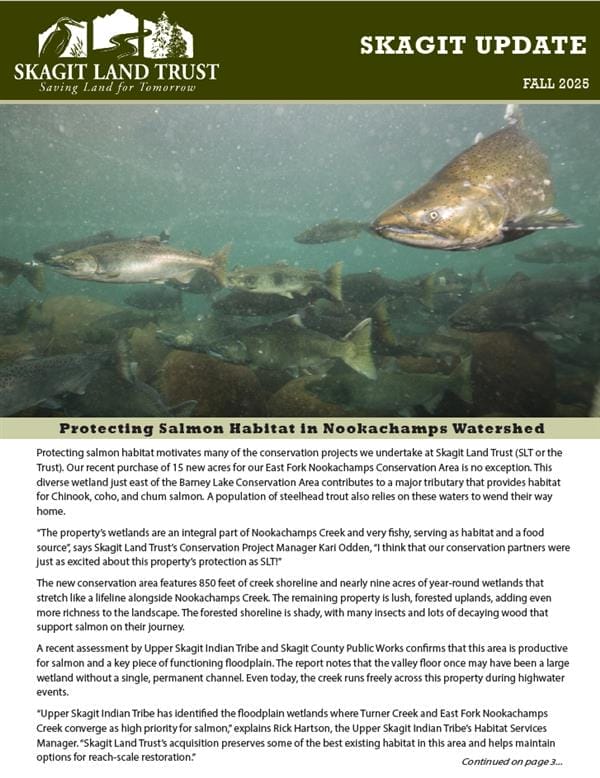
Our 2025 Annual Report/Fall Newsletter is Here
Our 2024-2025 Annual Report appears inside our Fall Newsletter, which also highlights some recent conservation events and activities.
View past annual reports below.
- Fall 2026 Newsletter & Annual Report
- 2025 Annual Report (Part of the Fall Newsletter)
- 2024 Annual Report (Part of the Fall Newsletter)
- 2023 Annual Report (Part of the Fall Newsletter)
- 2022 Annual Report (Part of the Fall Newsletter)
- 2021 Annual Report (Part of the Fall Newsletter)
- 2020 Annual Report (Part of the Fall Newsletter)
- 2019 Annual Report (Part of the Fall Newsletter)
- 2018 Annual Report (Part of the Fall Newsletter)
- 2017 Annual Report
- 2016 Annual Report
- 2015 Annual Report
- 2014 Annual Report
- 2013 Annual Report
- 2012 Annual Report
- 2011 Annual Report
- 2010 Annual Report
- 2009 Annual Report
- 2007 Annual Report
- 2006 Annual Report
- 2005 Annual Report
- 2004 Annual Report
Skagit Land Trust is a 501(c)(3) non-profit organization. Our Federal EIN number/Tax ID is 91-1533402.

Land Trust Accreditation
The Land Trust Accreditation program recognizes land conservation organizations that meet national quality standards for protecting important natural places and working lands forever. Skagit Land Trust was one of the first accredited land trusts in 2009 and was awarded renewed accreditation in 2015 and 2020. We are currently under review for our fourth round of accreditation.
As part of accreditation, Skagit Land Trust’s financial statements undergo a rigorous audit, which includes a risk assessment of our accounting and financial reporting systems. We received an unqualified, or “clean”, opinion on our financial statements. The Trust’s 990 and other filings are available to the public by calling 360-428-7878 or emailing info@skagitlandtrust.org.
National accreditation is the result of a rigorous independent analysis of Skagit Land Trust’s programs and practices. The Land Trust Accreditation Commission, an independent program of the Land Trust Alliance, conducts an extensive review of each applicant’s policies and programs.
The Accreditation Seal – Accredited land trusts are able to display a seal indicating to the public that they meet national standards for excellence, uphold the public trust and ensure that conservation efforts are permanent. For the full list of standards see this link.
Read the 2016 Saving Land Magazine article* about accreditation, featuring Skagit Land Trust Executive Director Molly Doran.
*If you need to access this PDF in another format, please send a request to us at info@skagitlandtrust.org