
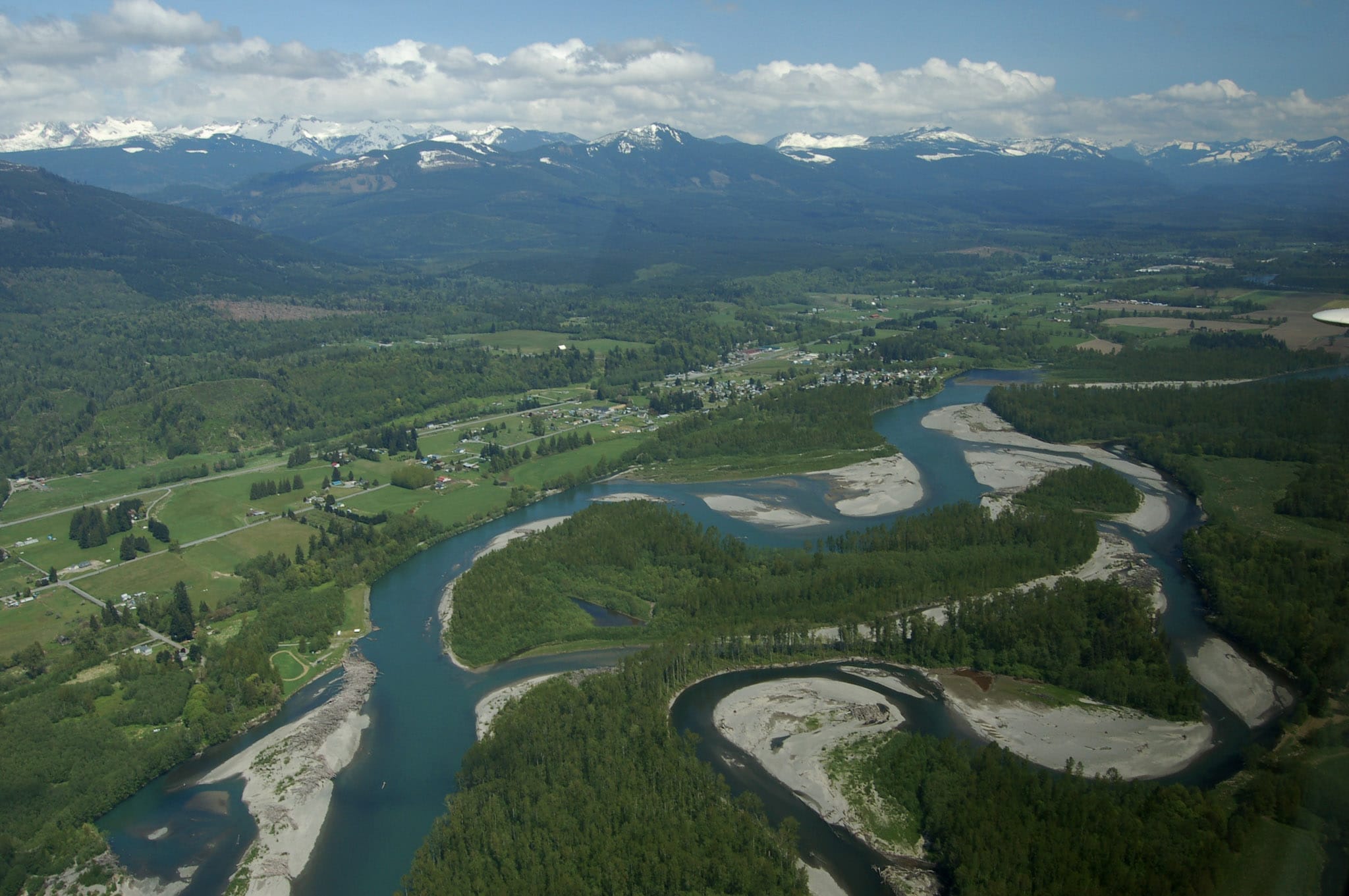
Skagit County – It’s Worth Protecting
With a population of 118,000 people, Skagit County in Northwestern Washington is a rural county renowned for its wild and scenic rivers, expansive floodplains, fertile agricultural lands, native forests and abundance of wildlife. This natural wealth, within 60 miles of the major metropolitan area of Seattle to the south and Vancouver B.C. to the north, makes the Skagit stand out as a special region in the United States.
The Skagit is an intersection of superlatives. It is a biologically and agriculturally rich, rural valley sandwiched between rapidly growing metropolitan areas. It is a green jewel holding the third largest river on the west coast of the lower 48 states. No less than 394 glaciers feed the Skagit River – the most glaciers left in a concentrated area in the continental United States. The Skagit is one of the largest strongholds of salmon remaining in the continental U.S., and hopes for restoration of salmon populations in Puget Sound hinge on this river.

The mixture of marine and freshwater corridors, agricultural areas and wetlands produces exceptional bird habitat. From bald eagles to peregrine falcons, to snow geese and trumpeter swans, there is no better place in Western Washington to see wintering populations of birds. The large contiguous eel grass beds of Padilla Bay help support mega heron colonies and a large range of marine species.

Millions of visitors pass through or come to the Skagit for its natural amenities annually. The Skagit serves as the gateway to North Cascades National Park on one side of the county and San Juan National Monument on the other. Add to this one of the largest forested areas remaining along the I-5 corridor, some of the least developed islands and marine shoreline, first-class soils and farmland, incredible vistas everywhere, a community deeply invested in their forest lands, agricultural lands and wildlife, and you have a remarkable intersection of unique natural features.

The Skagit is a nexus for people and nature. People choose to live here because of all the Skagit holds and its great diversity of ecosystems. It is natural then that Skagit Land Trust has evolved to protect a diverse array of natural lands to ensure ecosystem resiliency while also saving special places where people can appreciate Skagit’s beauty and natural heritage.
The natural riches in Skagit County are, however, under threat. With Skagit County’s location between two growing metropolitan areas, loss of our natural heritage is happening at an alarming rate. Sprawl and development are particularly placing lowland ecosystems in at risk – streams, floodplains, lowland forests, marine shorelines, freshwater wetlands and agricultural lands. Yet under this threat, our varied geography, rural economy, and flood-prone areas have allowed Skagit County to resist convergence to a suburb of Seattle/Everett to the south, or Bellingham to the north. Given our location and our community spirit, Skagit County offers one of the best chances for conservation of critical wildlife habitat, expansive open space, and the integration of nature and communities in Western Washington.