

- Property Type: Trust-Owned
- Date Added: 2005
- Cumberland Creek
- 202.5 acres
- Open to the Public, Featured Property
- Fishing
- Hiking & Walking
Conservation Story
Skagit Land Trust’s (SLT) Cumberland Creek Conservation Area protects over 200 acres of vital habitat and floodplain forest along the Skagit River, providing habitat for elk, birds, salmon and more. The Cumberland Creek Conservation Area was protected with financial assistance from the Washington State Salmon Recovery Funding Board, coordinated by the Skagit Watershed Council. SLT bought 25 acres in December 2005, followed by the addition of 143 acres in March 2006, 27 acres in November 2006, and an additional 15 acres in three separate transactions, including five acres of beautiful riparian forest in 2013.
Site History and Ecology
The Cumberland Creek Conservation Area is an excellent example of how rich in diversity the deciduous forests of the Skagit River floodplain can be. Cottonwoods, alders and big-leaf maples line the Skagit River and provide nutrients to the water, as well as habitat for many species of birds and amphibians. The Conservation Area also provides very important salmon habitat.

Access

We encourage you to visit this property! You can tour Cumberland Creek Conservation Area using our interpretive trail guide, created by the 2009-2010 Emerson High School Environmental Science class. As part of their curriculum, Emerson students studied the natural history of Cumberland Creek and created an educational brochure. As you walk the trails, you’ll find numbered posts corresponding to the brochure’s information.
How to Get There
From the South Skagit Hwy Park & Ride in Sedro-Woolley off of Route 9, take the S. Skagit Hwy 12 miles east. Follow directions for address 34183 or using the Google map link above. Look for parking area in front of locked gate on the left side of the road. Boardwalk and Skagit Land Trust signs are just beyond gate. Park in front of the gate and walk in. A good place to meet for carpooling is the Park and Ride area at the west entrance to South Skagit Highway on Highway 9.


You might also like

Executive Director’s Letter to Members
Dear Members and Partners, At Skagit Land Trust, we are deeply grateful for our volunteers, whose dedication helps us in…
Read MoreExecutive Director’s Letter to Members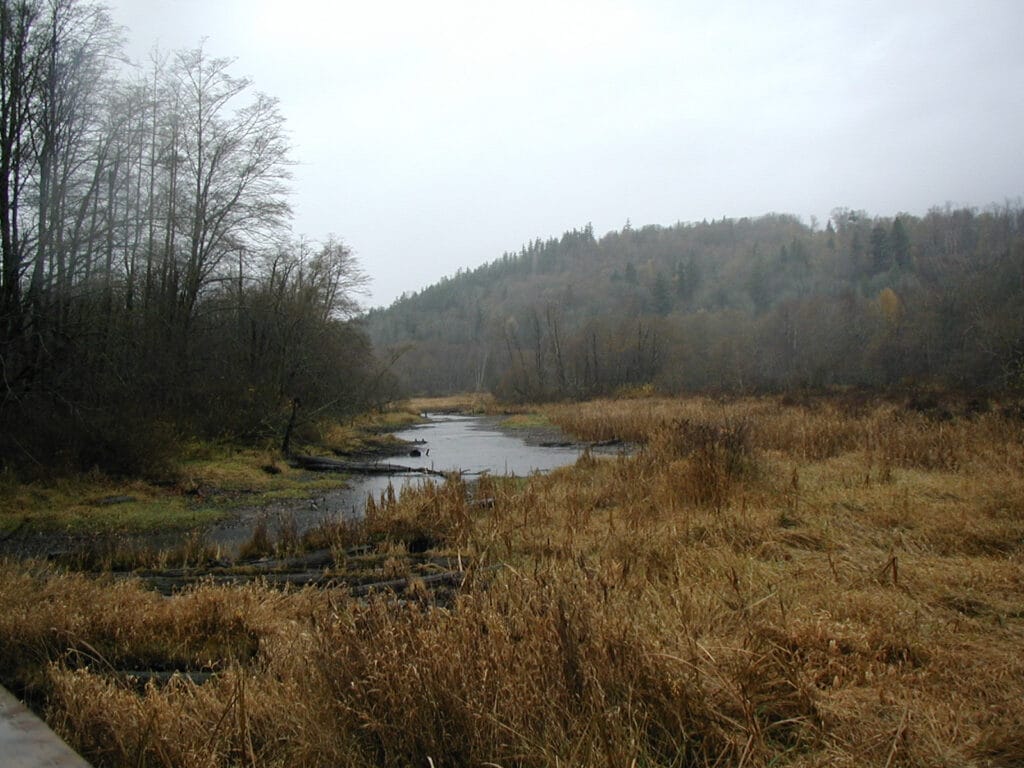
Three Conservation Areas Expand Skagit River Shoreline
Skagit Land Trust has acquired three properties to expand Skagit River shoreline, wetland, and forest protection for the benefit of…
Read MoreThree Conservation Areas Expand Skagit River Shoreline
Cumberland Creek Is Home at Last!
Restoring more than 4,000 feet of salmon habitat, Cumberland Creek has been diverted into its historic channel in a joint effort by…
Read MoreCumberland Creek Is Home at Last!