Land Acknowledgement
The lands conserved and protected by Skagit Land Trust have been inhabited and stewarded by numerous tribes and Indigenous peoples since time immemorial. We recognize and respect the inherent, indigenous, and treaty rights of the Coast Salish People, who have a deep and abiding connection to this place. Tribes within Skagit County include Samish Indian Nation, Sauk-Suiattle Indian Tribe, Swinomish Indian Tribal Community, and Upper Skagit Indian Tribe. In addition, Lummi Nation, Nooksack Tribe, Stillaguamish Tribe of Indians, and The Tulalip Tribes have ancestral and continued connections to these lands. We pay respect to the elders, tribal leaders, and members of each sovereign nation who continue to honor these lands through traditions that have been passed down through the generations. We acknowledge our responsibilities to care for these conserved and protected lands, both through sustainable stewardship practices and the core values that guide our work. We remain open to listening and learning from each tribe as we develop authentic relationships through our common regard for the land, water, air, and other living things.
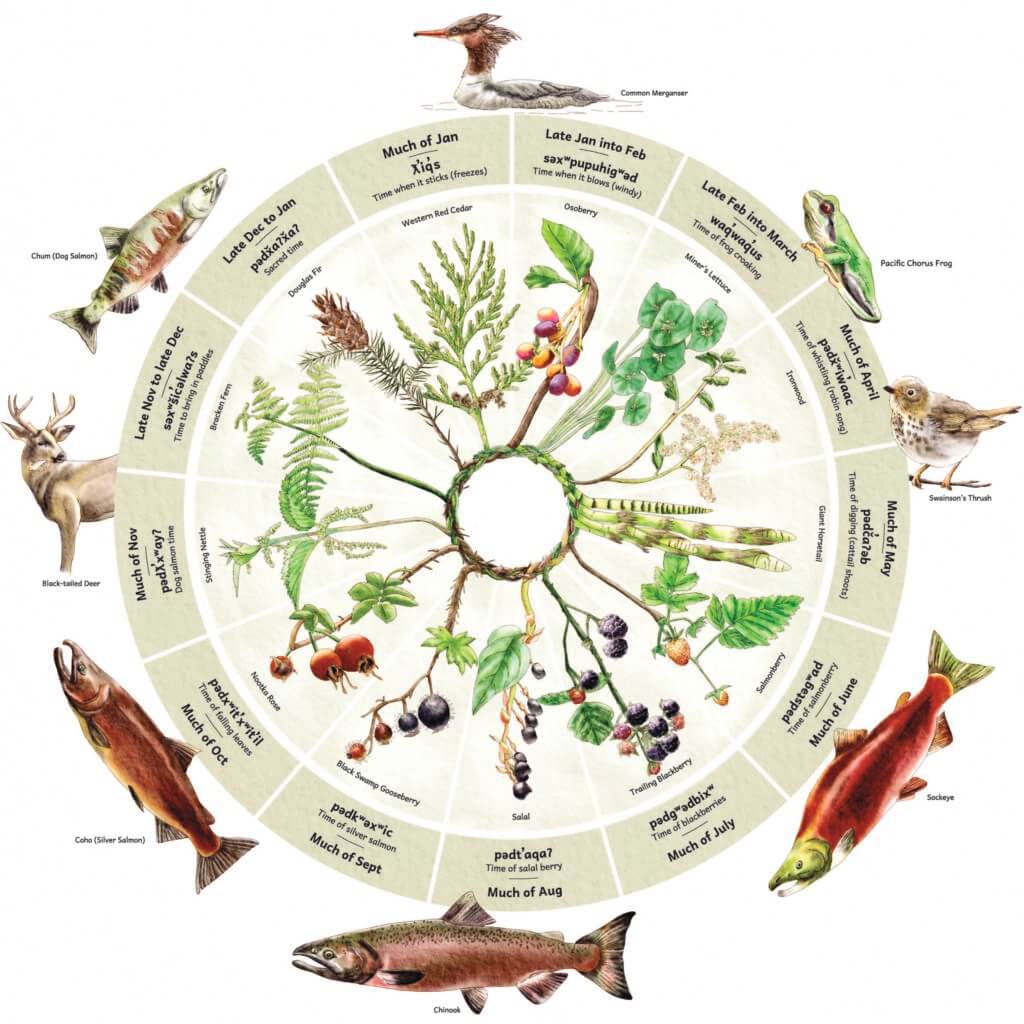
This seasonal round, created by Robin Bundi, was commissioned by Skagit Land Trust to display at Marblemount Conservation Area, which is located on the traditional territory of the Upper Skagit and Sauk-Suiattle Tribes. The round references the 13 moons lunar calendar, versions of which are used by the Upper Skagit, Sauk Suiattle, and other Coast Salish Tribes. Lushootseed words (the language common to these tribes) and their meanings reflect the important activity or event that occur at various times of the year.
Skagit Land Trust values past and present collaboration with tribal nations. The information below is from the individual websites for each of the four sovereign nations located in Skagit County. Please click through to learn more directly from them.
Samish Indian Nation
From their website: “The Samish Indian Nation is the successor to the large and powerful Samish Tribe, a signatory to the Treaty of Point Elliott in 1855. The Tribe’s traditional territory stretches over a wide region of the Salish Sea in Northwest Washington, from the tops of the Cascades Mountains to the far western shores of the San Juan Islands. The beauty, abundance and variety of the region since time immemorial provides a rich backdrop for our history and cultural traditions that remain strong today.”
Sauk-Suiattle Indian Tribe
From their website – “The Sauk-Suiattle Indian people have lived under the gaze of Whitehorse Mountain for many generations: as Fishermen, Gatherers and Hunters in the region of Sauk Prairie and near the present-day towns Darrington, Marblemount and Rockport, WA. In the early days, we were known as the Sah-ku-me-hu. Sah-ku-méhu homelands were the entire drainage area of the Sauk, Suiattle and Cascade Rivers. We had an important village at Sauk Prairie, near the confluence of the Sauk and Suiattle Rivers. The village consisted of eight traditional cedar longhouses which were destroyed in 1880s by early non-Indian settlers who had laid claim to these lands under the U.S. Homestead Act and Dawes Act.”
Swinomish Indian Tribal Community
From their website – “The Swinomish Reservation is located on Fidalgo Island in Western Washington State. It is the home of the Swinomish Indian Tribal Community, a federally recognized tribe. The Swinomish Tribe is descended from and is a successor to tribes, including Swinomish, Kikiallus, Samish and Lower Skagit, that inhabited the Skagit Valley and Puget Sound islands for thousands of years before non-Indian settlement.”
Upper Skagit Indian Tribe
From their website – “The Upper Skagit Indian Tribe is a federally recognized Indian tribe composed of eleven predecessor bands, including the Nuwha’ha, Nookachamps, Bsigwigwilts, Bsxwexwehwa’1, Chobahahbish, Sabelxu, Saylayotsid, Shayayotsid, Kwabatsabsh, Sahkumehu, and Skaywih. An original signatory of the Treaty of Point Elliott, the Upper Skagit people are descended from a tribe with eleven separate villages on the Upper Skagit and Sauk Rivers in Washington State. Our ancestors eventually consolidated, but a separate reservation was not originally established, and some tribal members had to reside on other reservations, primarily Swinomish. It was not until September 10, 1981, that the Upper Skagit Reservation was established.”